
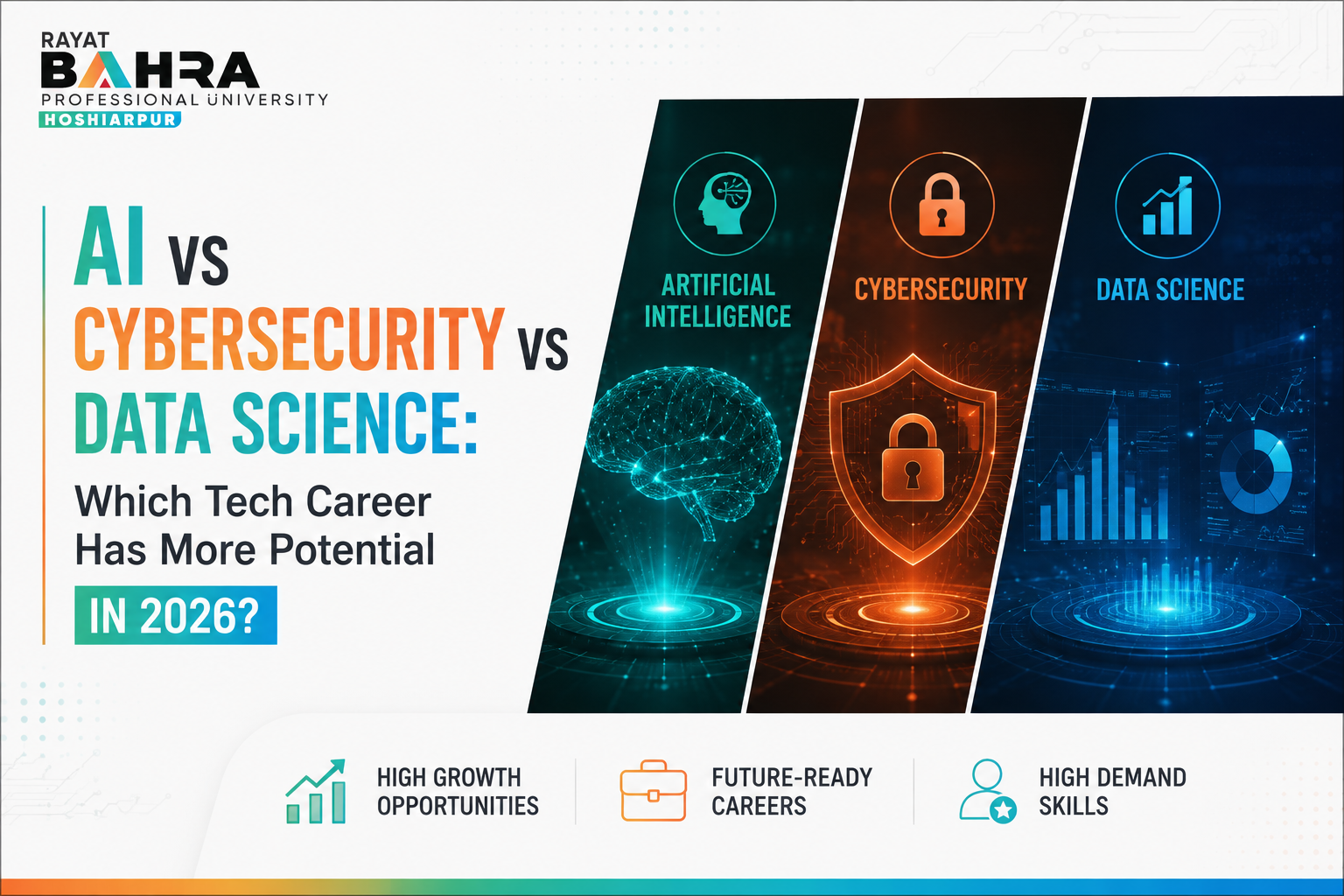
AI vs Cybersecurity vs Data Science: Which Tech Career Has More Potential in 2026?
Technology is changing almost every industry, from banking and healthcare to manufacturing, education, retail, and entertainment. As businesses become more dependent on digital systems and data, technology professionals are finding opportunities across a much wider range of industries.
For students considering a career in technology, three areas stand out in particular: Artificial Intelligence, Cybersecurity, and Data Science. All three offer strong career possibilities, but they involve different types of work and require different strengths.
So, which one should you choose?
The answer depends less on which field is “best” and more on what kind of problems you enjoy solving and where you see yourself working in the future.
Artificial Intelligence: Building Smarter Systems
Artificial Intelligence has moved from being a specialised area of research to becoming part of everyday business. Companies are using AI for customer service, fraud detection, recommendation systems, automation, content creation, healthcare analysis, and decision-making.
For students interested in programming, mathematics, machine learning, and problem-solving, AI can be an exciting career direction.
An AI professional may work on machine learning models, natural language processing, computer vision, predictive systems, or generative AI applications. As businesses continue exploring AI, professionals who understand both the technology and its practical applications are likely to remain valuable.
However, AI is also a field that requires continuous learning. Tools and techniques evolve quickly, so students entering this area should be prepared to keep upgrading their knowledge throughout their careers.
Cybersecurity: Protecting the Digital World
As more organisations move their operations online, protecting digital information has become a major business priority. A cyberattack can affect customer data, financial systems, business operations, and an organisation’s reputation.
This has increased the importance of cybersecurity professionals who can identify vulnerabilities, monitor networks, investigate incidents, and develop strategies to protect digital infrastructure.
Cybersecurity can be particularly suitable for students who enjoy problem-solving, technology, investigation, and understanding how systems work.
Career opportunities exist across IT companies, banks, government organisations, healthcare institutions, consulting firms, e-commerce businesses, and virtually every organisation that relies on digital systems.
The field also continues to evolve as technologies such as cloud computing, artificial intelligence, connected devices, and digital payments become more widespread.
Data Science: Turning Information Into Decisions
Every modern business generates enormous amounts of data. But data becomes valuable only when organisations can understand it and use it to make better decisions.
That is where Data Science comes in.
Data scientists and analysts work with large datasets to identify patterns, understand customer behaviour, forecast trends, and support business decisions. Their work can influence everything from marketing campaigns and financial planning to healthcare research and product development.
Students who enjoy statistics, mathematics, analytical thinking, and finding patterns may find Data Science particularly interesting.
The career path can lead to roles such as data analyst, data scientist, business intelligence professional, machine learning specialist, and analytics consultant.
AI vs Cybersecurity vs Data Science: What Is the Difference?
Although these fields overlap, their primary focus is different.
AI focuses on creating systems that can learn, predict, generate, or make decisions.
Cybersecurity focuses on protecting systems, networks, applications, and information from threats.
Data Science focuses on extracting useful insights from data and using them to support better decisions.
There is also considerable overlap between the three. AI can be used to identify cyber threats. Data Science can support the development of AI models. Cybersecurity professionals increasingly use data analytics and automation to detect unusual activity.
This interconnectedness means students do not necessarily have to think of these fields as completely separate career paths.
Which Tech Career Has More Potential?
There is no universal winner.
Choose AI if you enjoy programming, mathematics, machine learning, and building intelligent systems.
Choose Cybersecurity if you are interested in digital security, investigation, networks, and solving complex technical problems.
Choose Data Science if you enjoy statistics, analysing information, identifying patterns, and using data to answer business questions.
What matters most is developing a strong foundation in computer science, mathematics, analytical thinking, programming, and communication. These fundamentals can help students move between technology specialisations as their interests develop.
Why Industry Exposure Matters for Technology Students
Technology changes too quickly for students to depend entirely on classroom theory. Working on projects, participating in technical workshops, experimenting with modern tools, and understanding real industry problems can make the learning experience much more meaningful.
At Rayat Bahra Professional University, technology-focused education is designed around this changing industry environment. Students pursuing programmes in engineering and computer applications have opportunities to develop technical knowledge while engaging with practical learning and industry-oriented initiatives.
The university’s focus on emerging technologies, skill development, technical activities, and industry interaction helps students understand how concepts learned in classrooms are applied beyond the university environment.
What Should Students Learn Alongside Their Degree?
Regardless of whether you choose AI, Cybersecurity, or Data Science, your degree should be accompanied by practical skill development.
Students can strengthen their profile by learning:
- Programming languages such as Python
- SQL and database fundamentals
- Cloud computing
- Data visualisation
- Machine learning basics
- Cybersecurity fundamentals
- Version control and collaborative development
- Problem-solving and analytical thinking
- Communication and presentation skills
Building projects is equally important. A student who can demonstrate what they have built, analysed, or solved can often communicate their abilities more effectively than someone who only lists technologies on a resume.
The Future Is Not About Choosing One Technology
AI, Cybersecurity, and Data Science are likely to remain important as businesses become increasingly digital. But the technology industry is also becoming more interconnected.
A cybersecurity professional may use AI to detect threats. A data scientist may build machine learning models. An AI engineer may work with enormous datasets and cloud infrastructure.
This means the most valuable technology professionals may not simply be those who know one tool. They will be those who understand how different technologies work together to solve real problems.
For students choosing their career direction after Class 12, the best approach is to explore each field, understand the kind of work involved, and then choose the path that matches their interests and strengths.
The technology career with the most potential is ultimately the one you are willing to keep learning, experimenting, and growing in.